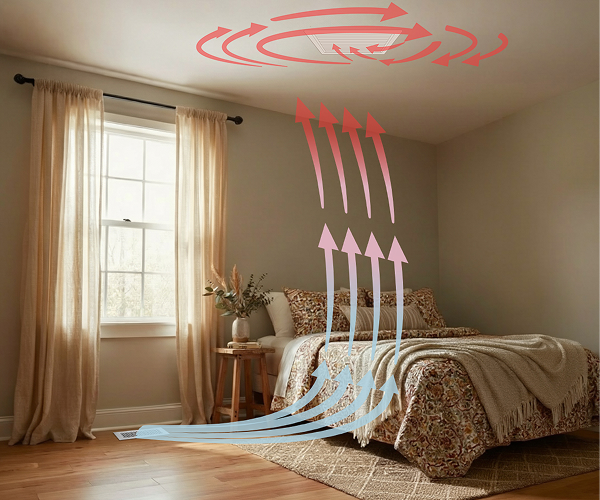
With a directional louver
With a directional louver, conditioned air gets thrown toward where you need it. Across the room. Into the space where you live. Your system does the same amount of work, but you actually feel it.


800.880.3090Proudly made in the USA

Proudly made in the USA
Most vents just push air. The right louver puts it exactly where you need it, and keeps it out of where you don't.
These aren't HVAC problems. They're airflow problems. And without the right louvers, you have no way to solve them.

A finished basement that never feels as cozy as the rest of the house, even when the heat is on.

By July, bedrooms upstairs can feel like saunas while the thermostat works in overdrive.

Conditioned air keeps flowing to spaces no one is using.

Even when the thermostat is set just right, some rooms still feel too hot or too cold.
With a directional louver, conditioned air gets thrown toward where you need it. Across the room. Into the space where you live. Your system does the same amount of work, but you actually feel it.
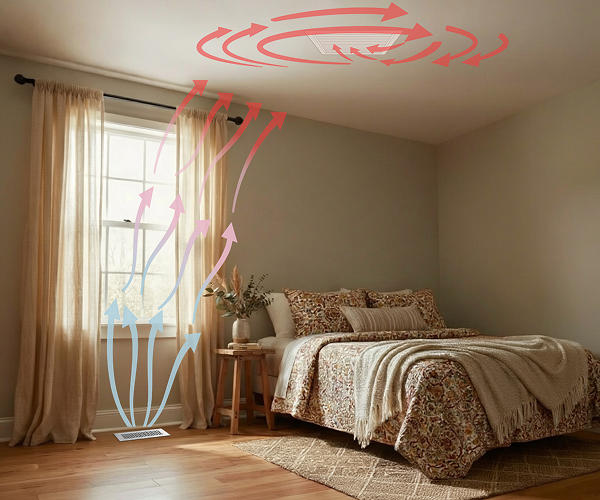
Without a directional louver, conditioned air blows up and out, gets lost near the window or barely reaches the people in the room before it loses its effect.
Every home has its comfort problem. Maybe it's the room that's always too hot or too cold. No matter how you set the thermostat, some room is still uncomfortable. The fix isn't a new HVAC system. It's smarter airflow at the vent level.
Every home has its hot spots and cold spots. Get the first floor comfortable and the second floor turns into a sauna. Cool down the upstairs and the basement feels like a walk-in freezer. No matter how you set the thermostat, some rooms are still uncomfortable. Smarter airflow at the vent level lets you take control , floor by floor and room by room.
Adjustable Louver. Open it, close it, or anywhere in between.
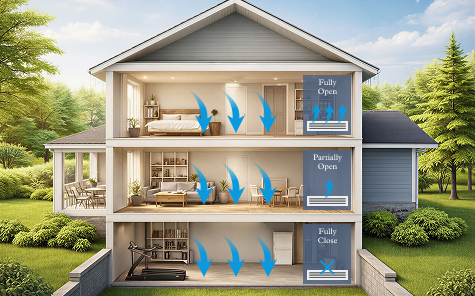

Heat rises, so your upper floors need the most cooling. Open the upper floor vents and open the main floor vents partially. Close the basement vents completely since basements stay cool on their own.
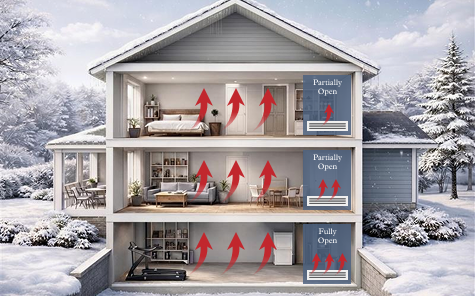

Flip the logic. Heat rises naturally to the upper floors on its own, so open those vents partially. Open the main floor vents partially and open the basement vents fully to push warm air up through the house. Otherwise, your upper bedrooms overheat while you're trying to sleep.
Once you've balanced airflow between floors, directional louvers make sure that air reaches you while it's still conditioned — before it rises to the ceiling and loses its effect.

Throw conditioned air toward the bed.

Direct air toward seating areas and away from walls.

Got a finished basement? Throw conditioned air toward the seating area.
In a two-story home, heat does exactly what it wants — it rises. Get the main floor comfortable and the upper bedrooms become unbearable by bedtime. Cool down the upstairs and the living room feels like a cave. The thermostat can only pick one. Smarter airflow at the vent level lets you balance both floors without the compromise.
Adjustable Louver. Open it, close it, or anywhere in between.
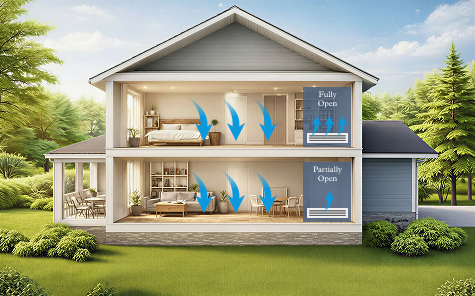
Heat rises, so your upper floor needs the most cooling. Open the upper floor vents fully and open the main floor vents partially to balance airflow between floors.
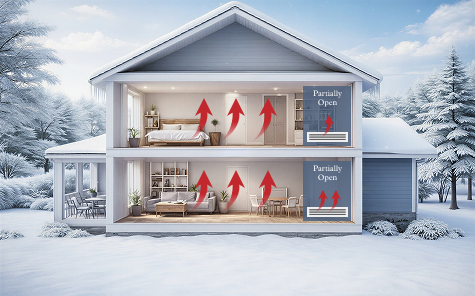
Flip the logic. Heat rises naturally to the upper floor on its own, so open those vents partially. Open the main floor vents fully to push warm air up through the house, letting it rise and heat the upper floors naturally.
Once you've balanced airflow between floors with adjustable louvers, directional louvers make sure that air reaches you while it's still conditioned — before it rises to the ceiling and loses its effect.
Throw conditioned air toward the bed
Direct air toward seating areas and away from walls.
In a single-story home, the problem isn't floors, it's rooms. The sun-drenched living room is sweltering while the back bedroom stays frigid. The guest room you use twice a year conditions air around the clock. The thermostat treats every room the same. Smarter airflow at the vent level lets you decide which rooms get the air and how much.
Adjustable Louver. Open it, close it, or anywhere in between.
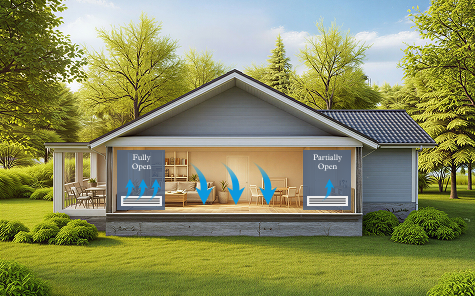
Sun-facing rooms need the most cooling. Open those vents fully. Open vents in regularly used rooms partially and close vents in unused rooms like guest rooms completely to redirect that conditioned air where it's actually needed.

Warm the rooms you use most. Open vents in main living areas fully and open bedroom vents partially. Close vents in unused rooms completely to concentrate heat where you need it most.
Once you've directed airflow to the right rooms, directional louvers make sure that air reaches you while it's still conditioned — before it rises to the ceiling and loses its effect.
Throw conditioned air toward the bed.
Direct air toward seating areas and away from walls.
In a commercial space, the thermostat can only do so much. A sun-drenched south-facing room in July has nothing in common with the shaded space down the hall. High-traffic areas need more cooling than the corridor beside them. Adjustable louvers let you direct conditioned air to the spaces that need it most, season by season, without a costly HVAC overhaul.
Adjustable Louver. Open it, close it, or anywhere in between.
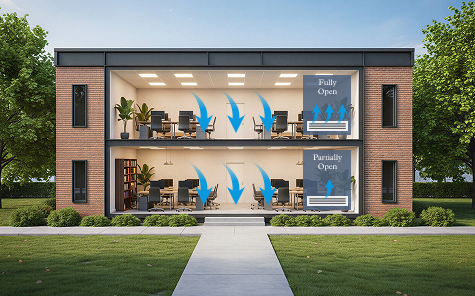
Direct the most cooling to sun-facing and high-traffic spaces. Open those vents fully. Open vents in regularly used spaces partially and close vents in low-traffic areas completely to redirect conditioned air where it's actually needed.

Concentrate heat in the spaces your people use most. Open vents in high-traffic areas fully and open vents in transitional spaces like corridors and lobbies partially. Close vents in low-traffic or unoccupied areas completely.
Once you've directed airflow to the right spaces, directional louvers make sure that air reaches occupants while it's still conditioned — before it rises to the ceiling and loses its effect.

Direct air toward occupied areas rather than letting it dissipate before it reaches desk level.

Throw conditioned air toward seating and gathering areas where people spend the most time.
An adjustable louver lets you control how much air enters a room. Open it all the way, close it down, or somewhere in between. Small adjustments make a whole-home impact.
→ Best for: Rooms you use occasionally: guest rooms, formal dining rooms, finished basements, or any space that doesn't need full-time heating and cooling.
A standard vent cover just lets air out. A directional louver puts it somewhere. The angled fins throw conditioned air in a specific direction, toward the bed, along the floor, into the room, so it reaches you before it rises and dissipates.
→ Best for: Every room with a supply vent. If air is coming out, it should go somewhere intentional.
Directional and adjustable louvers are available as add-ons for our Laser Cut Vent Cover Collection. Only adjustable louvers are available for our Quick Ship Vent Cover Collection.
Not sure where to start? Our directional louver guide can help you find the right fin configuration for your space. Still have questions? Our Customer Support team is happy to walk you through it. Give us a call at 800.880.3090.
Yes. By directing airflow where it's actually needed, directional louvers reduce energy waste and help your HVAC system maintain a consistent temperature more efficiently — rather than overworking to compensate for misdirected airflow.
Directional louvers are optional add-on fixed fins that attach to the underside lip of grilles from our Laser Cut Grille Collection, allowing you to direct airflow in a room. They come in different variations of fin placement to push warm or cool air in different directions exactly where it's needed. Because the airflow fins are fixed, the direction cannot be adjusted by the customer after installation, so be sure to select the right variation for your needs. Note that ordering directional louvers requires an underside lip for attachment.
No. An adjustable louver will not direct airflow. Our adjustable louvers have opposed horizontal blades, so opening or closing them will only change airflow volume, not airflow direction.
Directional louvers attach to the underside lip on the back of your grille, allowing you to angle airflow away from obstructions — like furniture, walls, or windows — and direct it out into the livable area of the room. For example, if a floor vent is positioned under a bed, a directional louver can redirect the air outward rather than losing it to the underside of the bed.
A vent deflector is an external add-on placed over an existing vent, typically made of plastic. A directional louver is built directly into the register itself, offering a more seamless, durable, and aesthetically pleasing solution for controlling airflow direction.
We offer one standard size register in cast iron with an adjustable louver attached. For all other sizes, products are sold as grilles with the option to add an adjustable louver or directional louver separately.
It's important to note that our adjustable louvers do not attach directly to the grille. Instead, they tension-fit into the duct opening and are adjusted using a screwdriver. Depending on your setup, you may need to remove the grille to make adjustments. If you order both an adjustable and directional louver, the grille will need to be removed to adjust the adjustable louver.
An underside lip is an optional feature available on our laser-cut steel and laser-cut aluminum grilles. It is a deep flange welded to the back of the grille that fits into your duct opening to help secure and position it. The underside lip also serves as the attachment point for directional louvers, so if you plan to add a directional louver, an underside lip is required.